
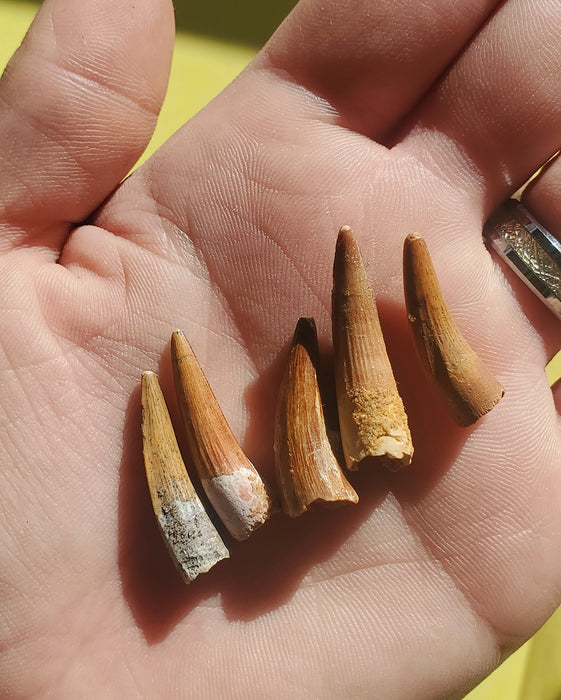
Baby Spinosaurus Tooth
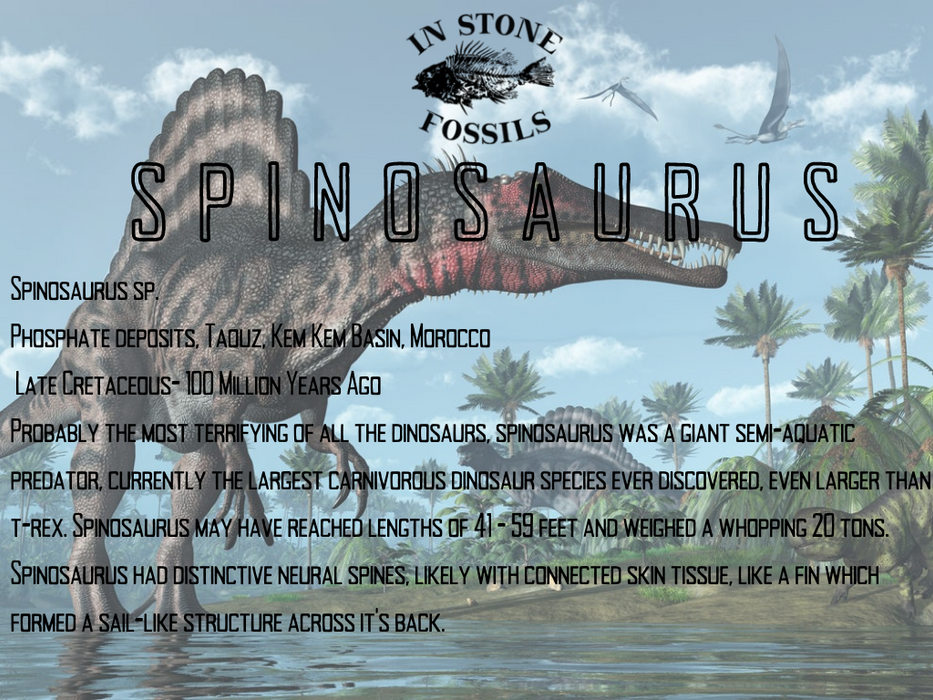
Spinosaurus sp.
Late Cretaceous (~95 million years ago)
Phosphate Deposits
Taouz, Kem Kem Basin, Morocco
Receive one tooth approximately 0.5" to 1" in length. Each tooth is handpicked for best quality and includes an info card. Photo is a representation of the tooth you'll receive.
Spinosaurus was a large spinosaurid theropod dinosaur that lived in North Africa during the Late Cretaceous, approximately 100–94 million years ago. Its remains are known primarily from Egypt and Morocco, although the taxonomy and reconstruction of the animal have changed substantially as new fossils have been discovered.
Anatomy
Spinosaurus was characterized by an unusually elongated body and skull, relatively short hind limbs, and enormous neural spines projecting from the vertebrae. These neural spines supported a tall sail-like structure along the back, particularly over the dorsal vertebrae. The function of the sail remains uncertain; proposed interpretations include display, thermoregulation, species recognition, or some combination of these.
The skull was long and narrow, superficially resembling that of a large crocodilian. Its jaws contained conical, relatively straight teeth rather than the laterally compressed, blade-like teeth typical of many other large theropods. The snout and anterior jaws were adapted for grasping prey, and the skull possessed openings and structures associated with spinosaurid feeding adaptations.
The forelimbs were robust and ended in three clawed fingers. The first digit bore a particularly large claw. Compared with many other giant theropods, the hind limbs were proportionally shorter, contributing to an unusual overall body plan.
Ecology and behavior
Evidence from its skull, teeth, and associated sediments indicates that Spinosaurus had a strong association with aquatic environments. Fish appear to have been an important component of its diet, including very large fish preserved in the same North African river systems.
However, the precise degree of aquatic adaptation remains controversial. Some anatomical studies have proposed that Spinosaurus was a specialized aquatic predator capable of substantial swimming, whereas others interpret it as primarily a semiaquatic, shoreline-associated animal that foraged in shallow water much like a large wading or swimming predator.
Size
Estimates of Spinosaurus's total length have varied considerably because the known skeletons are incomplete and different specimens have been reconstructed differently. Historically, estimates around 14–18 m (46–59 ft) have been proposed. Its mass is considerably harder to estimate, and published estimates have varied widely.
Consequently, claims that Spinosaurus was definitively the largest theropod are not settled scientifically. Comparisons with Tyrannosaurus, Giganotosaurus, and other giant theropods depend heavily on which reconstruction and body-mass model is used.
Geological setting
The best-known Moroccan material comes from the Kem Kem Group, deposited in riverine and floodplain environments during the Cenomanian. These deposits preserve an exceptionally distinctive vertebrate assemblage containing numerous large predatory and aquatic animals.